
Today, I started thinking about pomegranates, because I was asked for the first time in my life, to deseed one.
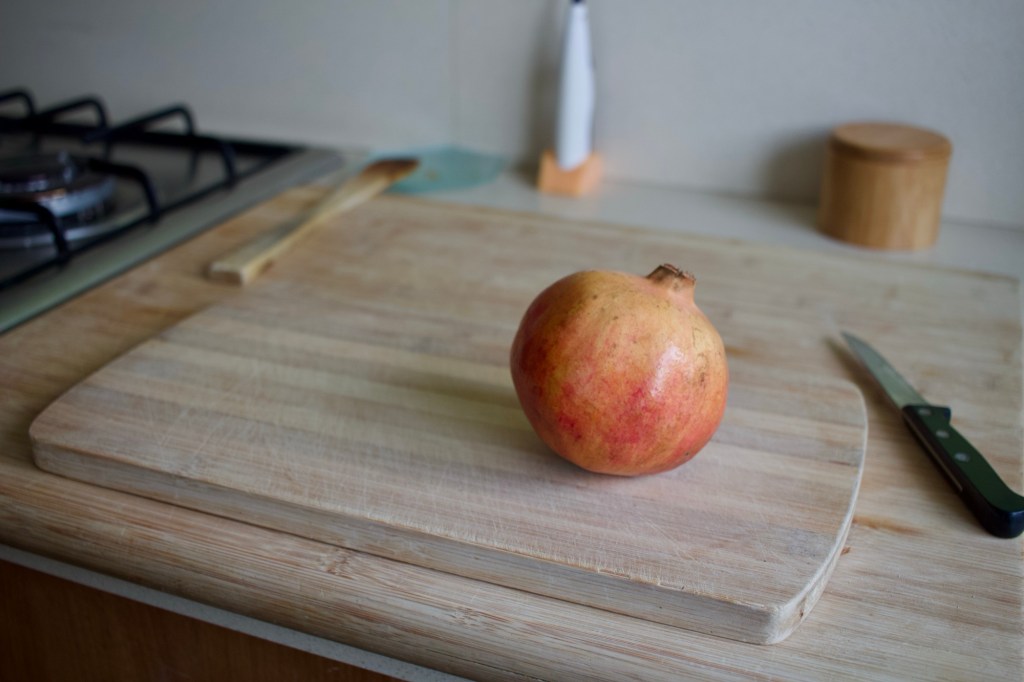
Derived from the Latin pōmum grānātum, meaning “seeded apple,” the pomegranate carries layers of symbolism across different cultures and myths—representing sanctity, death, abundance, and fertility depending on the story.
Greek and Roman Mythology
In ancient Greece, the pomegranate symbolized both death and fertility. According to myth, Hades, the god of the underworld, used pomegranate seeds to bind Persephone to him. By eating just a few seeds, she was tied to the underworld, destined to spend part of each year there—a story interpreted as a metaphor for the changing seasons.
The fruit was also linked to Aphrodite, the Greek goddess of love, and Hera, the goddess of marriage and birth. In Roman tradition, newlywed women wore crowns woven from pomegranate leaves, and the fruit’s juice was believed to cure infertility.
In Christianity, the pomegranate represents Christ’s suffering and resurrection. Its abundance of seeds symbolizes eternal life and spiritual fruitfulness.
Symbolism in Middle Eastern traditions
The Quran describes pomegranates as one of God’s good creations, growing in the gardens of Paradise.
In ancient Iranian culture, the pomegranate was associated with the Garden of Eden and is sometimes considered the true forbidden fruit. During Yalda Night, the winter solstice festival, Iranians traditionally eat pomegranates to celebrate the victory of light over darkness.
Jewish Tradition
During Rosh Hashanah (the Jewish New Year), it is traditional to eat pomegranates, as their numerous seeds symbolize abundance and fruitfulness for the coming year.
En España
I’m currently on holiday in Spain, and the pomegranate (granada in Spanish) adorns the national coat of arms, symbolizing the Kingdom of Granada.

We’d just come back from a lovely long walk by the beach.
I was looking forward to having a little snooze when my husband reminded me that his mother had asked me to take the seeds out of the pomegranate. It felt more sensible to just get on with the task and then have my nap later. So I did just that.
Of course, I didn’t have a clue how to do this—why would I? Mostly, when I eat pomegranate seeds, they’re from little plastic boxes from my local supermarket. I suppose I’d never even given a thought to the process by which they arrived in this form.

So I did what any reasonable person in the 21st century does: I Googled it and found a YouTube video.


It was fairly simple, and less than half an hour later, I was left with a bowl of juicy-looking seeds.

Somehow, I managed to display high levels of self-control and not eat many of the pomegranate seeds! It was interesting for me to note that I despite feeling quite tired when I started this process, it did not tire me and I in fact found the whole process quite soothing, meditative even. I will also remind myself that I am in-fact on holiday with nothing else to do…

I did, however, wonder why this wasn’t something I did more regularly at home. It had never occurred to me to buy a pomegranate. I might give it more thought next time I find myself at either the international supermarket near my home or near my mother’s home.
Then, of course, I’ve got to work out what to do with the seeds. The most obvious thing is to put them in a salad—which I’m sure will have to contain feta cheese. Somehow, feta cheese and pomegranate seeds seem to be an inevitable combination in my head.

If you have any ideas for salads with pomegranate seeds, please do share!
So that’s it for now…until the next post Adiós!


